




CLESS High-Stratification Buffer Tanks
CLESS High-Stratification Buffer Tanks | Matteoda

CLESS High-Stratification Buffer Tanks

CLESS Buffer Tanks: high-stratification thermal storage

CLESS is a range of buffer tanks developed by REQA for thermal energy management in heating systems.

The system is designed to improve the way heat is transferred between the heat generator, the storage tank and the heating circuit, while maintaining correct thermal stratification inside the tank.

Thanks to the patented compensation-chamber system, water flows are managed in order to reduce mixing between the hot and cold areas of the buffer tank, helping make thermal energy available where and when it is needed.

How the CLESS By-pass system works

One of the main features of the range is the By-pass system, which manages the relationship between the heat generator and the heating circuit.

When the generator and the heating system operate with equivalent flow rates, the compensation chambers allow direct thermal exchange between the two circuits.

When the generator produces more energy than the heating system requires, the excess heat is transferred towards the upper section of the buffer tank, progressively charging the storage volume.

When the heating system requires stored energy, hot water is drawn from the upper section of the tank, where thermal stratification concentrates the available heat.

Three configurations for different heating systems

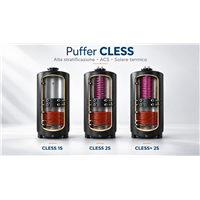
The CLESS range includes three different product families, designed for different system requirements.

RangeDHW productionSolar thermalMain application
CLESS 1SNoYesTechnical heat storage
CLESS 2SYesYesBiomass and gas boilers
CLESS+ 2SYes, with enlarged heat exchangerYesHeat pumps

CLESS 1S

CLESS 1S is the configuration mainly intended for technical heat storage. It does not include a domestic hot water heat exchanger, while it incorporates the heat exchanger dedicated to the solar thermal circuit.

CLESS 2S

CLESS 2S includes a heat exchanger for domestic hot water production and is particularly recommended by the manufacturer for applications with biomass heat generators and gas boilers.

CLESS+ 2S

CLESS+ 2S uses an enlarged DHW heat exchanger and is the configuration developed for applications with heat pumps.

Domestic hot water production

In CLESS 2S and CLESS+ 2S models, domestic hot water is produced by means of a dedicated heat exchanger positioned in the upper section of the buffer tank.

The DHW heat exchanger is removable and is immersed in the area where the highest temperatures are concentrated, allowing instantaneous domestic hot water production without using the buffer tank itself as a direct potable-water storage vessel.

Solar thermal integration

The CLESS range is designed for integration with solar thermal systems by means of a dedicated heat exchanger.

The energy produced by solar collectors can therefore be transferred to the buffer tank and used together with the other heat generators connected to the system.

The system can therefore be integrated with different energy sources, including:

  • biomass boilers;
  • gas boilers;
  • heat pumps;
  • solar thermal systems.

CLESS buffer tanks for biomass systems

In biomass heating systems, the CLESS system manages heat transfer between the generator, the storage tank and the heating circuit, without necessarily requiring the entire buffer volume to be brought up to temperature before energy can be supplied to the heating system.

The compensation-chamber system also helps reduce the direct return of the coldest water from the bottom of the storage tank to the heat generator.

CLESS buffer tanks for heat pumps

The CLESS+ 2S range is specifically configured for use with heat pumps.

Thermal storage can help maintain heating-system continuity during defrost cycles and reduce compressor micro-cycling.

100 mm thermal insulation

CLESS buffer tanks use 100 mm thick recycled polyester-fibre insulation, designed to reduce heat losses.

The insulation is externally protected by a PVC Seta Skin covering, also designed for installations where the buffer tank remains visible.

Which CLESS Buffer Tank should you choose?

The correct configuration depends on the type of heat generator, whether domestic hot water production is required and the characteristics of the heating system.

System requirementRecommended range
Technical heat storage without DHW productionCLESS 1S
Storage with DHW for biomass or gas boiler systemsCLESS 2S
Storage with DHW for heat pump systemsCLESS+ 2S

The correct storage capacity should be selected according to the heat generator output, the building's energy demand, the type of heating terminals and the domestic hot water requirement.

CLESS Buffer Tanks can be ordered. Contact our customer service team to check the most suitable model for your system and the relevant delivery times.

Frequently asked questions about CLESS Buffer Tanks

What is a CLESS Buffer Tank?

CLESS is a high-stratification thermal storage tank featuring a compensation-chamber system that manages water flows between the heat generator, buffer tank and heating circuit.

What is the difference between CLESS 1S, CLESS 2S and CLESS+ 2S?

CLESS 1S is mainly intended for technical heat storage, CLESS 2S includes domestic hot water production and is recommended for biomass and gas-boiler applications, while CLESS+ 2S uses an enlarged DHW heat exchanger and is configured for heat pumps.

Can CLESS Buffer Tanks be connected to a solar thermal system?

Yes. The range includes a dedicated heat exchanger for the solar thermal circuit.

Can CLESS be used with a pellet boiler?

Yes. CLESS can be installed in systems using biomass heat generators. CLESS 2S is recommended by the manufacturer for biomass applications when domestic hot water production is also required.

Can CLESS be used with a heat pump?

Yes. The CLESS+ 2S configuration has been specifically developed for heat pump applications.

Do all models produce domestic hot water?

No. CLESS 1S does not include a DHW heat exchanger, while CLESS 2S and CLESS+ 2S are equipped with a heat exchanger for domestic hot water production.

How should the buffer tank capacity be selected?

The capacity should be selected according to the heat generator, installed output, building demand, system characteristics and domestic hot water requirement. Final sizing should be checked by a qualified technician.

Sorry for the inconvenience.

Search again what you are looking for

Follow us on Facebook